Agentic Workflow
Agentic Multi-Agent Workflow for Marketing Personalisation
Video Case Study: Agentic Workflow
Executive summary
Personalization at scale is the "last mile" problem in modern marketing. While segmentation is easy, generating distinct, brand-safe creative for 12+ segments is a manual bottleneck. I architected an Agentic Multi-Agent System that mimics a human marketing team, autonomously analysing customer data, drafting strategy, and generating creative—all while maintaining strict brand guardrails via a "Human-in-the-Loop" architecture.
Overview, Strategy & Execution
The Problem
True personalization requires more than inserting a {{First_Name}} tag. A "Luxury Buyer" needs a narrative of exclusivity, while a "Cart Abandoner" needs urgency and reassurance.
The Bottleneck: Writing unique, strategic copy for dozens of micro-segments is time-prohibitive.
The Risk: Marketers do not trust "black box" AI generation. If an AI hallucinates a discount that doesn't exist, it causes financial and reputational damage.
The Solution: A 5-Agent Hierarchy
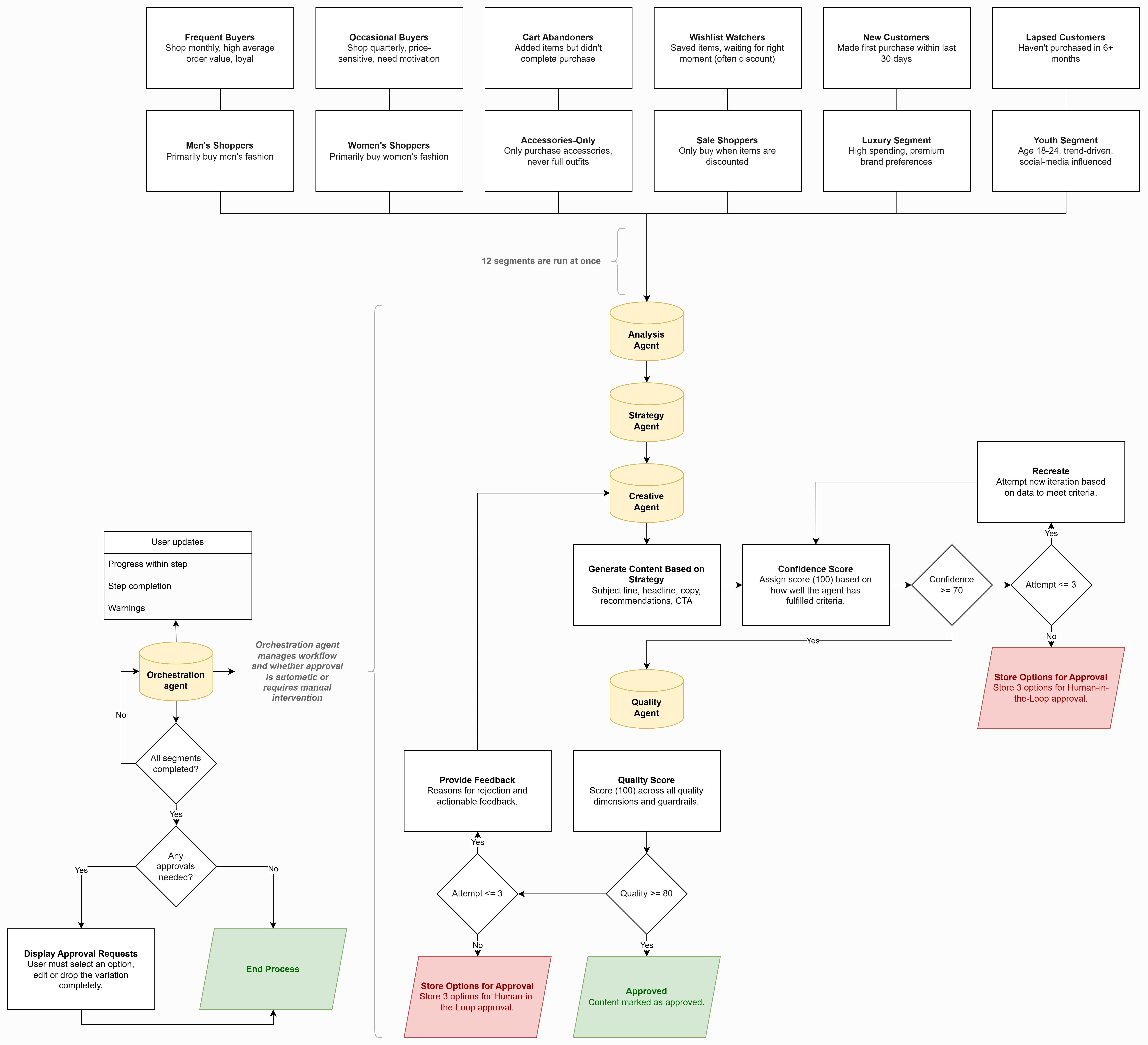
I designed a system where specialized agents hand off tasks sequentially, separating Strategy from Execution to prevent "strategic drift."
1. The Orchestration Layer (The Manager)
Role: Parallel Processing Manager.
Function: Instead of processing segments linearly, the Orchestrator spins up simultaneous workflows for all 12 target segments (e.g., Lapsed Users, High-Value, Cart Abandoners), managing dependencies and data flow.
2. The Strategic Analysis Layer
Analyst Agent: Ingests raw segment data to build a psychological profile (e.g., "This segment is price-sensitive and urgency-driven").
Strategy Agent: Converts the profile into a creative brief. It defines the objective, offer logic, and constraints before any copy is written.
Constraint Logic: "For Luxury Buyers, strictly forbid discount language. Focus on status."
3. The Creative Execution Layer
Creative Agent: Receives the locked brief and generates the email copy.
Self-Correction Loop: The agent assigns itself a Confidence Score. If the score is below 70%, it autonomously regenerates the copy up to three times before escalating, ensuring only high-quality drafts reach the next stage.
4. The Guardian Layer (Quality Assurance)
QA Agent: Acts as the "Brand Guardian." It audits the output against the original brief and brand guidelines.
Logic Check: It verifies offer accuracy (e.g., "Did we include the free shipping code mentioned in the strategy?").
Rejection Protocol: If an error is found, it rejects the draft and sends specific feedback back to the Creative Agent for a re-write.
The "Human-in-the-Loop" Dashboard
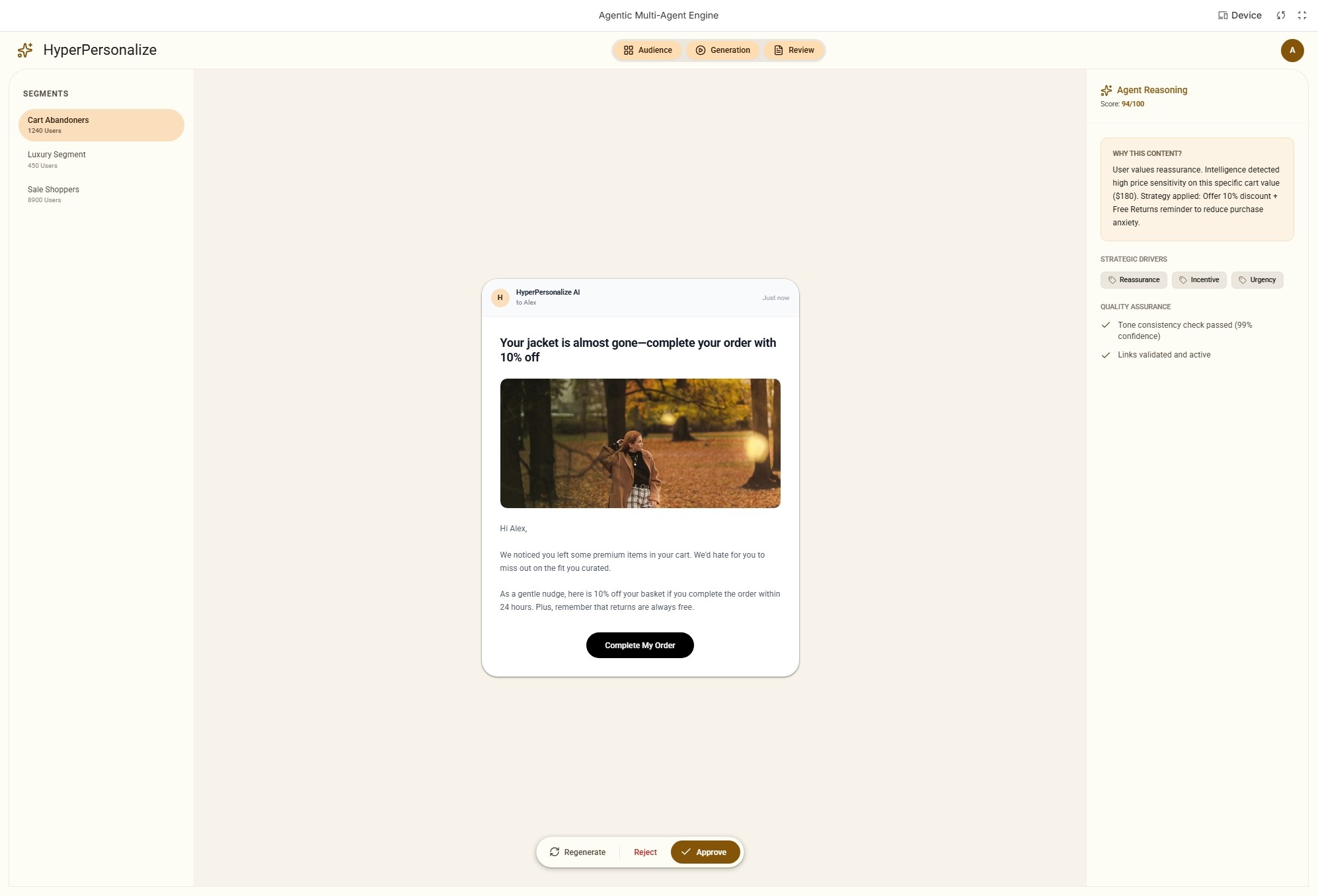
Trust is built through transparency. I designed a prototype dashboard that visualizes the agents' reasoning in real-time.
The "Red Bucket" Protocol: The marketer does not review every email. They only review the "Edge Cases"—drafts that failed the QA Agent's checks multiple times.
Scale without Loss of Control: This reduces days of manual copywriting to minutes of review, allowing marketers to focus on strategy rather than execution.
Technical Competencies Demonstrated
Multi-Agent Orchestration: Designing hierarchical agent interactions with clear hand-off protocols.
Autonomous Self-Correction: Implementing "Reflexion" loops where agents grade and fix their own work.
Guardrail Engineering: Using QA agents to enforce brand safety and offer logic.
Human-Computer Interaction (HCI): Designing interfaces that expose AI reasoning to build user trust.
More case studies
Hire Me
Ready to discuss how strategic product leadership can drive your business goals? Then let's get in touch.