AI Prose Engine
Modular State-Machine Architecture for LLM Narratives
A modular, state-machine architecture for LLM fiction. It solves context drift by treating narrative arcs as variable states, ensuring deep consistency.
Executive summary
Large Language Models (LLMs) inherently suffer from "context drift" and "model collapse" over long-form generation tasks. To mitigate this, I engineered a modular architecture that enforces state consistency across a 50,000+ word narrative. By treating narrative elements as discrete variables rather than static descriptions, the system functions as a logic gate, requiring the model to validate state parameters (sanity, environment, lucidity) before executing prose generation.
Overview, Strategy & Execution
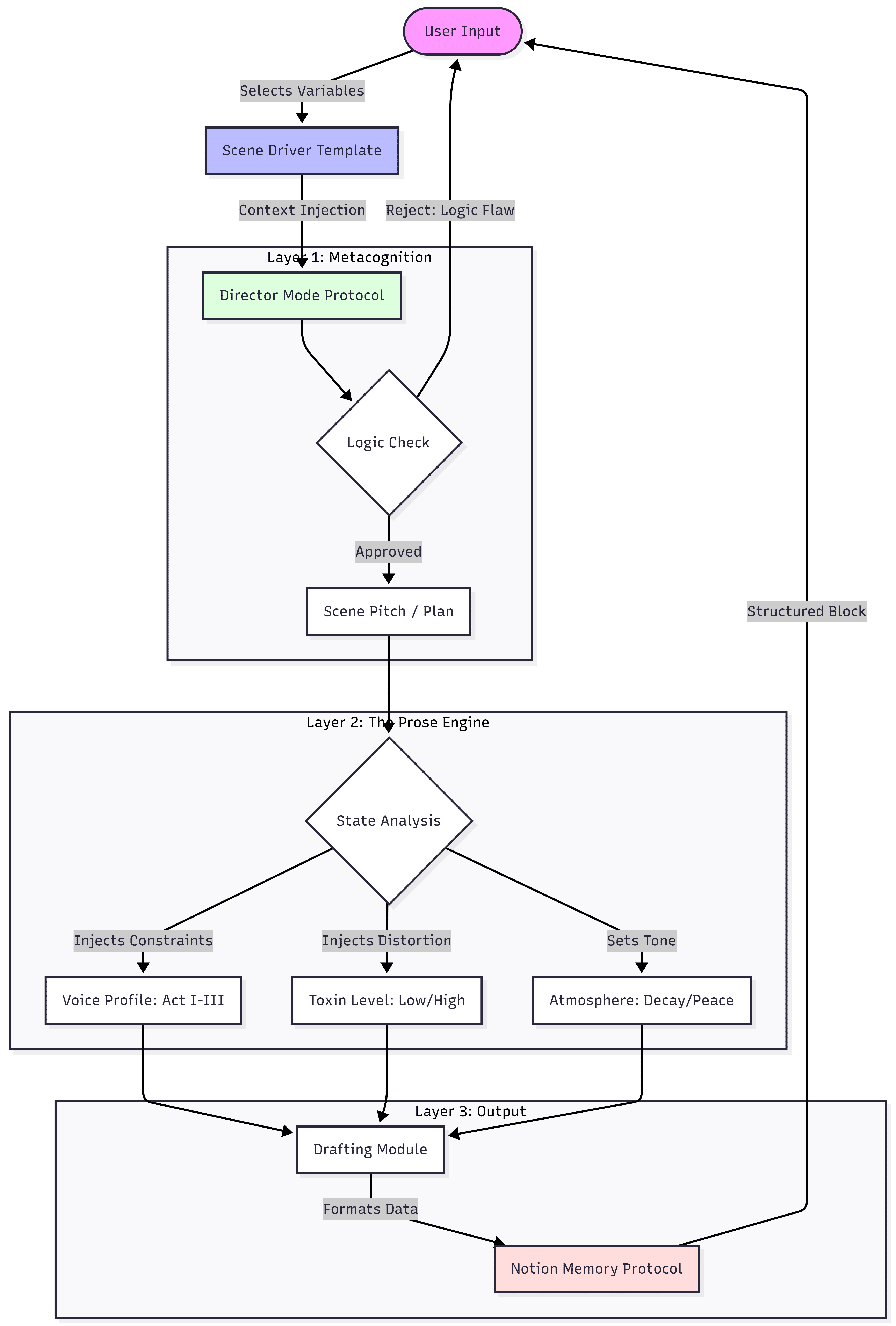
System Architecture: The 4-Module Pipeline
1. Metacognitive Control Layer (The "Director Mode")
Objective: Mitigate logic hallucinations and enforce narrative pacing.
Mechanism: Implementation of a Chain-of-Thought (CoT) Loop. The system is strictly forbidden from immediate generation. It must execute a
STOP > ASSESS > PITCH > EXECUTEsequence.Adversarial Prompting: Explicit "Anti-Sycophancy" constraints force the model to challenge user inputs that violate established narrative logic, preventing the model from passively drifting into incoherence.
2. Dynamic State Management (The "Prose Engine")
Objective: Prevent "voice flattening" over long contexts by mapping syntax to temporal and psychological states.
Implementation: The system utilizes Temporal State Mapping, creating a dependency between the narrative timeline (Acts) and linguistic constraints:
State A (Baseline): Enforces high-entropy, subject-verb-object syntax for stability.
State B (Degradation): Enforces run-on sentences and recursive "checking" behaviors to simulate anxiety.
State C (Collapse): Enforces syntactic fragmentation and sensory-dominant reporting.
Result: The model automates the degradation of the protagonist's internal monologue based on the
[Act_ID]variable, rather than requiring manual style re-prompting.
3. Runtime Parameter Injection (The "Scene Driver")
Objective: Eliminate context drift by refreshing critical constraints at the moment of inference.
Mechanism: A Context Injection Template passed before every generation. This allows for granular, boolean control over the simulation parameters:
Toxicity_High: Triggers specific hallucination sub-routines (e.g., visual distortions, temporal bleeding).Lucidity_Low: Triggers unreliable narrator constraints.Atmosphere_Decay: Enforces specific sensory lexicons (damp, rot, nitrate).
Technical Benefit: This enables non-linear generation. The user can generate a high-toxicity scene immediately following a baseline scene without model retraining or lengthy context re-loading.
4. Structured Data Serialization (The "Memory Protocol")
Objective: Solve the unstructured data problem inherent in chat interfaces.
Mechanism: The system is instructed to wrap all generative output in specific metadata headers (
[SCENE_ID],[POV_STATE],[WORD_COUNT]).Interoperability: This standardizes the output for direct ingestion into external databases (Notion, SQL) via API or manual parsing, treating the LLM as a structured content API rather than a chatbot.
Technical Competencies Demonstrated
LLM State Management: Architecting prompts that treat narrative status as mutable variables.
Reflexion Patterns: Implementing "Assess before Execute" loops to improve logic coherence.
Context Optimization: Utilizing concise "Driver" templates to maximize instruction adherence while minimizing token usage.
Structured Output Engineering: Formatting natural language generation for downstream application integration.
More case studies
Hire Me
Ready to discuss how strategic product leadership can drive your business goals? Then let's get in touch.